Published by:
CGP EDU Academic Team
Published on: September 13, 2026
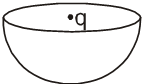
A charge q is placed at the center of an imaginary hemispherical surface. Using symmetry arguments and the Gauss’s law, find the electric flux due to this charge through the given surface.
Text Solution
Verified by ExpertsThe correct answer is:
A
Step 1: According to Gauss's law, the total electric flux \(\Phi_E\) through a closed surface is given by the equation:
\[ \Phi_E = \frac{Q_{enc}}{\epsilon_0} \]
where \(Q_{enc}\) is the total charge enclosed within the surface and \(\epsilon_0\) is the permittivity of free space.
Step 2: Here, the surface is a hemispherical closed surface with charge \(q\) placed at the center. Because the charge is at the center of the hemisphere, it is essentially enclosed by this imaginary hemisphere if we consider an entire sphere.
Step 3: Since the charge \(q\) is the only charge enclosed by the hemisphere, we can write:
\[ Q_{enc} = q
\Phi_E = \frac{q}{\epsilon_0} \]
However, this equation gives the flux through a full closed surface (a sphere).
Step 4: The hemispherical surface represents half of a closed sphere, so the flux through the hemispherical surface will be half of the total flux:
\[ \Phi_{hemisphere} = \frac{1}{2} \left(\frac{q}{\epsilon_0}\right) = \frac{q}{2\epsilon_0} \]
Therefore, the electric flux through the hemispherical surface due to the charge \(q\) is given by \(\frac{q}{2\epsilon_0}\).
Final answer: Therefore, the electric flux through the given surface is \(\frac{q}{2\epsilon_0}\).
\[ \Phi_E = \frac{Q_{enc}}{\epsilon_0} \]
where \(Q_{enc}\) is the total charge enclosed within the surface and \(\epsilon_0\) is the permittivity of free space.
Step 2: Here, the surface is a hemispherical closed surface with charge \(q\) placed at the center. Because the charge is at the center of the hemisphere, it is essentially enclosed by this imaginary hemisphere if we consider an entire sphere.
Step 3: Since the charge \(q\) is the only charge enclosed by the hemisphere, we can write:
\[ Q_{enc} = q
\Phi_E = \frac{q}{\epsilon_0} \]
However, this equation gives the flux through a full closed surface (a sphere).
Step 4: The hemispherical surface represents half of a closed sphere, so the flux through the hemispherical surface will be half of the total flux:
\[ \Phi_{hemisphere} = \frac{1}{2} \left(\frac{q}{\epsilon_0}\right) = \frac{q}{2\epsilon_0} \]
Therefore, the electric flux through the hemispherical surface due to the charge \(q\) is given by \(\frac{q}{2\epsilon_0}\).
Final answer: Therefore, the electric flux through the given surface is \(\frac{q}{2\epsilon_0}\).
Prepare Smarter with CGP Edu
Get practice questions, solutions, and test series in one place.
Write a Review
Share your experience with this question and solution.
Commentary
Send your comment, doubt, correction, or feedback to admin.
Similar Questions
Explore conceptually related problems
A cylinder of radius R and length L is placed in a uniform electric field E parallel to the cylinde…
Electric field at a point varies as $r_{0}$ for
An electric charge q is placed at the center of a cube of side α. The electric flux on one of its f…
Total electric flux coming out of a unit positive charge put in air is
For a given surface the Gauss's law is stated as $\oint \mathbf{E} \cdot d\mathbf{s} = 0$ . From th…
A cube of side l is placed in a uniform field E, where $\mathbf{E} = \mathbf{E} \hat{i}$ . The net …